
Trace Clark County Sentence Authority
A release-date question begins with the order that controls custody. Municipal Court may authorize bond or resolve a misdemeanor. Common Pleas may impose a felony sentence, calculate jail-time credit, order community control, or grant judicial release. ODRC administers a state prison term and publishes its own date fields. Sheriff Records documents the county jail's physical exit. Each record has a narrow role.
When dates conflict, compare when each source was updated. Common Pleas states that its online docket updates nightly through the prior business day, so a new entry may lag. The ODRC expected field may change after a credit or board action. A VINE alert may arrive near a custody event but still requires confirmation. Preserve the source date and do not overwrite an actual book-out with an older projection.
Read Clark County Expected Dates
ODRC's combined expected-date field needs its definition beside it. A record can also show APA supervision, expected or transitional-control dates, and a board result. None of those labels alone establishes the day the gate opened. Compare the current status, sentence information, and release detail before drawing a conclusion.
The official ODRC definitions screen explains Expected Release Date, Parole Eligibility Date, POA, PRD, and supervision terms.
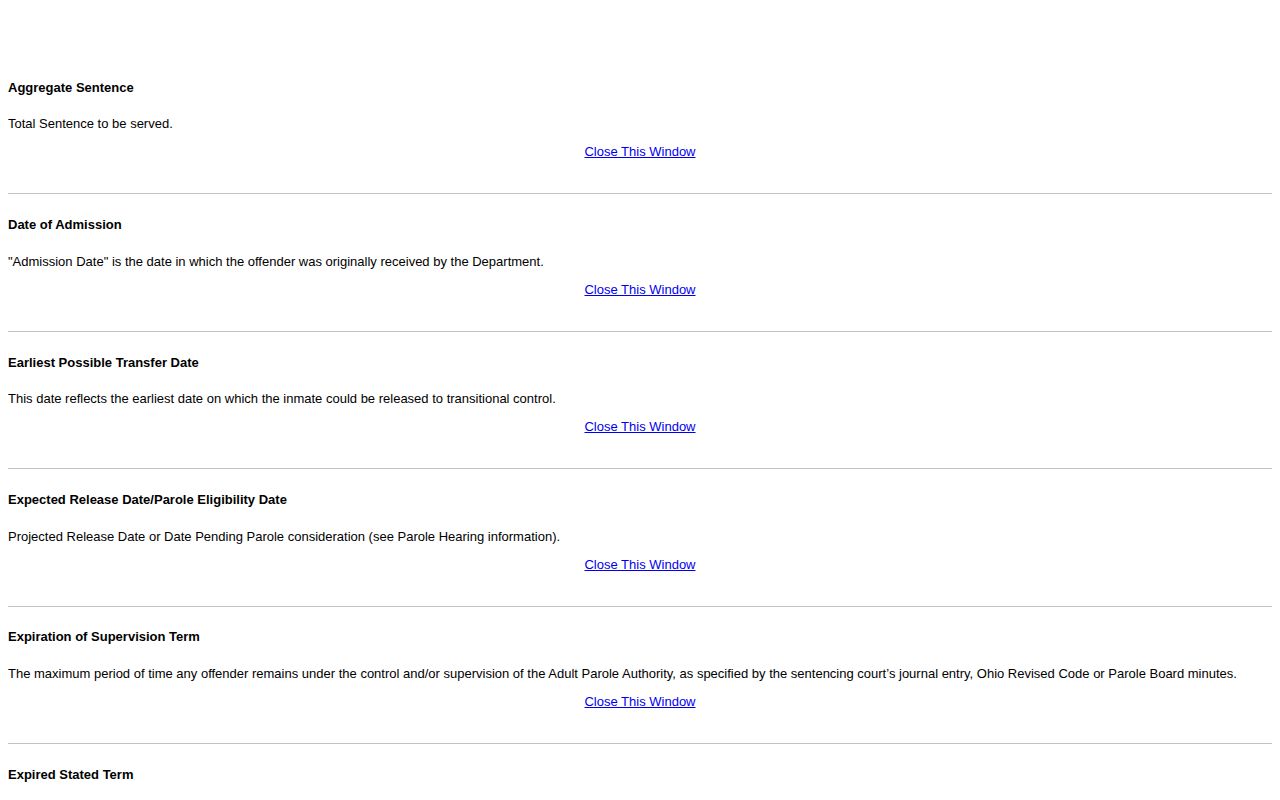
The captured definitions show why the combined field is an estimate or eligibility point, not a guaranteed Clark County release.
An official ODRC detail example shows APA supervision with expected and transitional-control information and a board result.
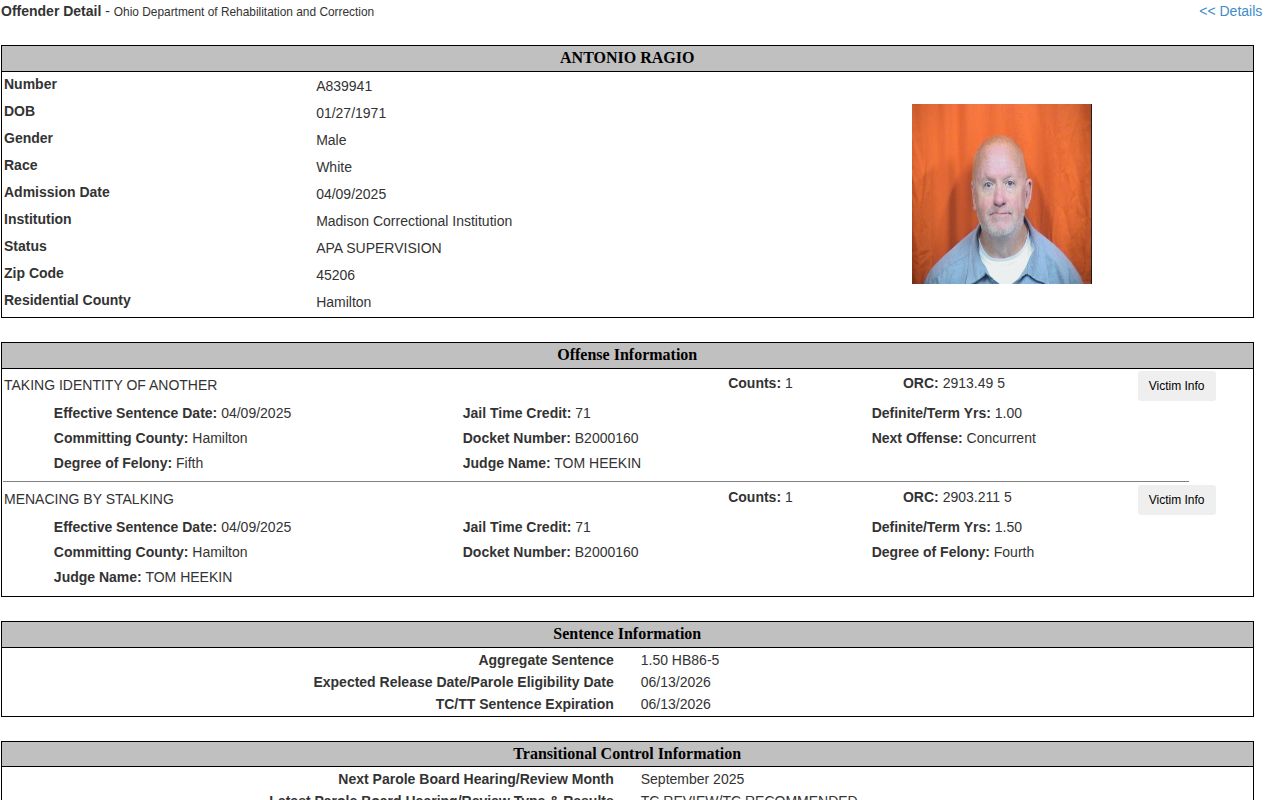
That interface evidence reinforces the need to preserve each field's label. It does not turn a future date into a confirmed departure.
Clark County Expected Versus Actual Release
A projected date forecasts when a sentence may reach a release point under the information then available. An actual date records when custody ended. The ODRC definitions explain that its combined field can mean Expected Release Date or Parole Eligibility Date. Those are not the same event. Eligibility means a person may be considered for parole; it does not promise a grant or an exit that day.
A person held before trial usually has no fixed sentence-completion date. Release may depend on bond, recognizance, dismissal, a plea, a court order, or another hold. Someone serving a county jail sentence may have a court term and jail-time credit but no ODRC profile. A sentenced state prisoner belongs in the ODRC search. Mixing these systems creates false certainty.
| Date or status | What it means | What it does not prove |
|---|---|---|
| Expected Release Date | ODRC's current projection | Actual departure |
| Parole Eligibility Date | Possible consideration point | Parole approval |
| Release detail | Recorded state release event | Freedom from all holds |
| County court order | Legal authority or sentence | Exact jail book-out time |
Find Clark County Prison Release Dates
Use the ODRC Offender Search for a person sentenced to state prison. Search by name or offender number and match the record carefully. County of Commitment can help identify a Clark County case, but a person may be housed anywhere in Ohio. Residential County applies to supervision records and can be last-recorded data.
- Open the official ODRC search and enter the strongest known identifier.
- Match the offender number, conviction, and county before reading the date.
- Read status, expected release or parole eligibility, jail-time credit, release detail, supervision dates, and any board result together.
- Check the sentencing court when the sentence or credit shown online appears incomplete.
- Confirm a past release through the release detail or ODRC Central Records rather than relying on an earlier forecast.
The ODRC record may show Released, Judicial Release, APA Supervision, or a Violators at Large status after prison. Each label describes a different stage. Judicial release is a court-ordered early departure from state prison. APA Supervision means the person is in the community under state authority, while VAL signals an alleged supervision violation and possible recustody.
Clark County Jail Release Timing
The Clark County Jail path begins with the official jail page and its current-custody roster. That roster can show whether the jail currently reports a person, but it has no future release calendar and no released archive. A name that disappears may reflect bond, time served, transfer, state commitment, another hold, a data issue, or another custody outcome.
Read both local court systems when necessary. Municipal Court handles misdemeanors and the early stage of felony cases. Common Pleas handles felony cases after indictment or bindover. The docket may show bond, sentence length, jail-time credit, dismissal, community control, judicial release, or an ODRC commitment. It is a legal record, not the physical book-out clock.
For the exact county event, ask Clark County Sheriff Records for book-in and book-out date and time, release type, releasing authority, and transfer destination if one exists. The full request path is also covered on the Clark County released inmates home page.
Clark County Jail-Time Credit
Jail-time credit reduces the prison term for qualifying confinement already served in connection with the offense. Revised Code 2967.191 directs ODRC to reduce the stated prison term by the credit calculated by the sentencing court. The court entry controls the amount. The online ODRC detail may display credit, but an omission or dispute should be checked against the sentencing record.
Credit is not the same as earned credit. Jail-time credit accounts for qualifying time already confined. Earned credit may reduce a term after participation or conduct under a separate statute. Neither should be estimated from arrest and sentence dates alone. Consecutive cases, detainers, or sentence corrections can change the result.
- Jail-time credit
- Qualifying confinement credited by the sentencing court.
- Earned credit
- A statutory reduction tied to qualifying activity and limits.
- Detainer
- A request or order that another authority hold or receive the person.
- Parole eligibility
- A date for possible parole consideration, not release.
Clark County Earned-Credit Limits
Ohio changed the main calculation for qualifying credit earned after April 4, 2024. Revised Code 2967.194 sets an ordinary aggregate ceiling of fifteen percent and contains many exclusions and conditions. That ceiling is why an “eighty-five percent” shortcut sometimes appears. It is only a bounded mathematical explanation, not a universal promise that every Ohio prisoner leaves after serving that share.
Eligibility turns on the offense, sentence, timing, conduct, and statutory exclusions. Credit can also be denied, limited, or lost under the governing process. For a non-life indefinite sentence, Revised Code 2967.271 adds a presumptive-release framework and possible continued-incarceration determination. For parole-eligible sentences, Revised Code 2967.13 governs eligibility. These paths cannot be reduced to one calculator.
Note: Use the statute version in force for the sentence and ask ODRC or counsel about an individual computation dispute.
Why Clark County Release Dates Move
A projected date changes when the facts or legal authority change. Some changes move it earlier, while others delay release or redirect the person to another custodian. The most useful check compares the newest ODRC detail, sentencing docket, and any release or board entry rather than preserving an old screenshot as the answer.
| Factor | Possible effect | Best record |
|---|---|---|
| Earned credit | May reduce a qualifying term within limits | ODRC calculation and statute |
| Credit loss or discipline | May remove an assumed reduction | ODRC record |
| Jail-time credit correction | Changes remaining term | Sentencing entry |
| Judicial release | Court may authorize earlier prison departure | Common Pleas order and ODRC detail |
| Parole result | Grant, denial, or continuance changes timing | Board result in ODRC record |
| Detainer or hold | May cause transfer instead of community release | Custodian and receiving agency |
| New court order | Can amend or vacate prior timing | Current docket |
A county jail handoff to ODRC, federal custody, ICE, another county, or treatment is a transfer. It may create a Clark jail book-out date without community release. The receiving system then controls the next projected date.
Confirm Clark County Actual Release
After the expected day arrives, check the source that held the person. For ODRC, read the updated status and release detail. For Clark County Jail, obtain the sheriff's release record and check the court docket for the legal basis. If another authority received the person, continue with that custodian rather than calling the transfer “released.”
Ohio VINE can provide a prospective custody-change alert for participating county jails and ODRC, but it is not a permanent release archive. Register while the person is in custody and confirm any alert with the custodian. The VINELink inmate search explains the phone, email, SMS, and confirmation process.
The date should be recorded with its label and source: expected release, parole eligibility, judicial release order, jail book-out, state release detail, or supervision discharge. That small distinction prevents a forecast from being repeated later as an actual event.
Public Record Search
Sponsored Results