
Trace Clark County Supervision Authority
Start with the legal event that ended custody. A state-prison release with parole or post-release control points to APA. A Common Pleas entry imposing community control points to Clark County Adult Probation. A jail release on bond points back to the court and any pretrial conditions. If the sheriff record says transfer, follow the receiving custodian before assuming community supervision began. This custody-to-court-to-agency sequence prevents an ODRC miss from being treated as proof that no conditions exist.
Clark County Parole Versus Probation
Clark County parole and probation use two systems. The Ohio Department of Rehabilitation and Correction Offender Search can show a person on Adult Parole Authority supervision after state prison. Clark County Adult Probation handles felony defendants whom Common Pleas Court placed on community control, generally instead of sending them to state prison. Community control is the Ohio court term for sanctions served in the community.
A recognizance or bond release is a third path. It ends the jail stay while a case proceeds and may impose pretrial conditions, but it does not prove guilt and is not parole or probation. The court docket identifies that status. These distinctions matter because a search in the wrong system may return no result even though another agency has authority.
| Status | Who orders it | Where to verify |
|---|---|---|
| Parole or post-release control | State framework after prison | ODRC record and named APA office |
| Community control | Clark County Common Pleas Court | Court docket and Adult Probation |
| Pretrial release | Municipal or Common Pleas court | Current docket and release order |
- Parole
- Conditional community release under APA authority.
- Post-release control
- A supervision term imposed after certain Ohio prison sentences.
- Community control
- Court sanctions supervised locally instead of a prison term.
- Discharge
- The formal end of a custody or supervision term.
Clark County Supervision Record Fields
The official ODRC interface can place status, residential county, supervision start, supervision period, expiration, named APA office, release detail, and a board result on one matched record. Read them as a set. Residential county is a last-recorded connection, not a verified current address. A supervision start may follow the prison exit, while the expiration may later change through formal action.
The official ODRC example shows how Clark residential county, SPRINGFIELD 1, a VAL warning, and supervision fields can coexist.
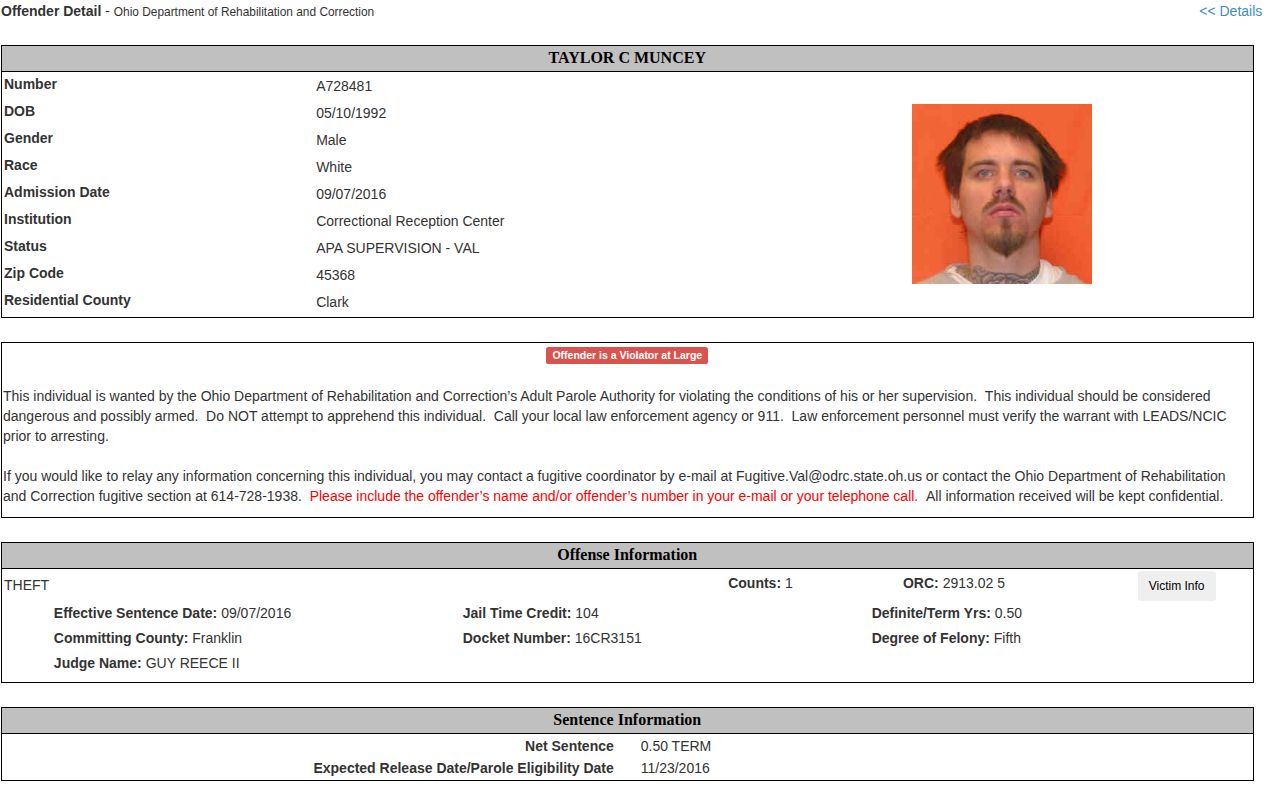
The image demonstrates the interface and field placement. It is not a live location tool, and the example subject is not material for republication.
Check Clark County Parole Records
For a Clark County state-prison release, search ODRC by name or offender number. Choose APA Supervision as the status. Residential County may be set to Clark when that connection is relevant, but ODRC says residential data can be last-recorded information rather than a live location. Open the correct detail only after matching identifiers.
- Search the official ODRC database and compare the name and offender number.
- Read the displayed status without treating an expected date as the actual prison exit date.
- Note the supervision start, period or expiration, APA office, and any release or board detail.
- Use the office named on the record or ODRC Central Records when an exact status or correction is needed.
ODRC examples show that a Clark-linked record may name SPRINGFIELD 1. Research did not verify a current public street address or phone for that unit, so none should be inferred. A state record may also concern an older offense. Match the sentence and supervision fields before connecting it to a recent release.
Clark County Probation Office Records
Clark County Adult Probation supervises people placed on felony community control and prepares presentence reports. Its published structure includes Basic and Intensive units. The Common Pleas docket is the first source for the order, terms, later modifications, and a filed termination. Then the office can confirm how to route a question about its own record.
101 N. Limestone St., Room 112
Springfield, OH 45502
937-521-1711
Chief: 937-521-1717
The office is not the Clark County Jail and cannot replace the sheriff's physical book-out record. Likewise, ODRC's APA filter is not the county probation lookup. A court order for community control points to the county office, while an ODRC APA status points to state supervision.
Note: Use the filed court entry to identify the controlling sentence before asking either supervision office to confirm a status.
Clark County Parole Record Limits
Ohio public-record law does not make every supervision file public. Revised Code 149.43 excludes records tied to parole, probation, community-control, and post-release-control proceedings in specified circumstances. Revised Code 5120.21 also limits full inmate and APA files while allowing ODRC to disclose defined items such as a name, convictions, photograph, supervision status, and places of incarceration.
A narrow request works better than asking for the entire parole file. Ask ODRC Central Records for releasable supervision status or discharge information and identify the person precisely. For county probation, request the public sentencing and termination entries from the Clerk and direct a status question to Adult Probation. A lack of online detail may reflect a restricted proceeding, an old case, or a mismatch. It is not proof that supervision never existed.
Clark County Violators at Large
ODRC has a dedicated Violators at Large, or VAL, filter. A VAL flag means the Adult Parole Authority reports that a person is wanted for an alleged supervision violation under Revised Code 2967.15. It does not establish a new conviction, and the last residential county or address is not a verified present location.
Do not approach someone based on a VAL result. ODRC's public interface directs information about a listed person to Fugitive.Val@odrc.state.oh.us or 614-728-1938 with the person's name and offender number. Emergencies go to 911, and law enforcement must confirm a warrant. A violation flag also does not erase the historical prison release. It signals possible noncompliance and recustody after that event.
Clark County Reentry After Release
The Clark County Department of Reentry serves people returning from jail or prison and their families. Its PATH program focuses on the first year following prison release. Officially listed help includes identification navigation, transportation for critical needs, immediate necessities, links to treatment or benefits, record-sealing clinics, and peer support.
This help is separate from supervision. A person may work with reentry staff while reporting to APA, county probation, or neither. Current drop-in hours should be confirmed at 937-521-3860 because two county pages differ slightly. The county services page is the best place to check the present list before traveling.
Correct Clark County Release Records
Post-release needs often include a state ID and an accurate custody history. Clark Reentry specifically lists identification help. A record error, however, must go to the office that created it. Send jail booking or photo errors to Sheriff Records, ODRC status errors to Central Records, and Common Pleas online errors to the Clerk at 937-521-1680.
Keep each date distinct. The prison exit, supervision start, expiration, alleged violation, and final discharge can all differ. An APA expiration is not necessarily the actual prison-release date. The full Clark County search and sheriff release-record path appears on the released inmates home page, while state expected dates are explained on the inmate release date page.
Note: Preserve the exact label and date from each official system so a later update does not get mistaken for the original release.
Public Record Search
Sponsored Results